Ardha Cakrāsana (Half Wheel Pose): Classical Sources, Anatomy, Alignment & Evidence-Based Guide
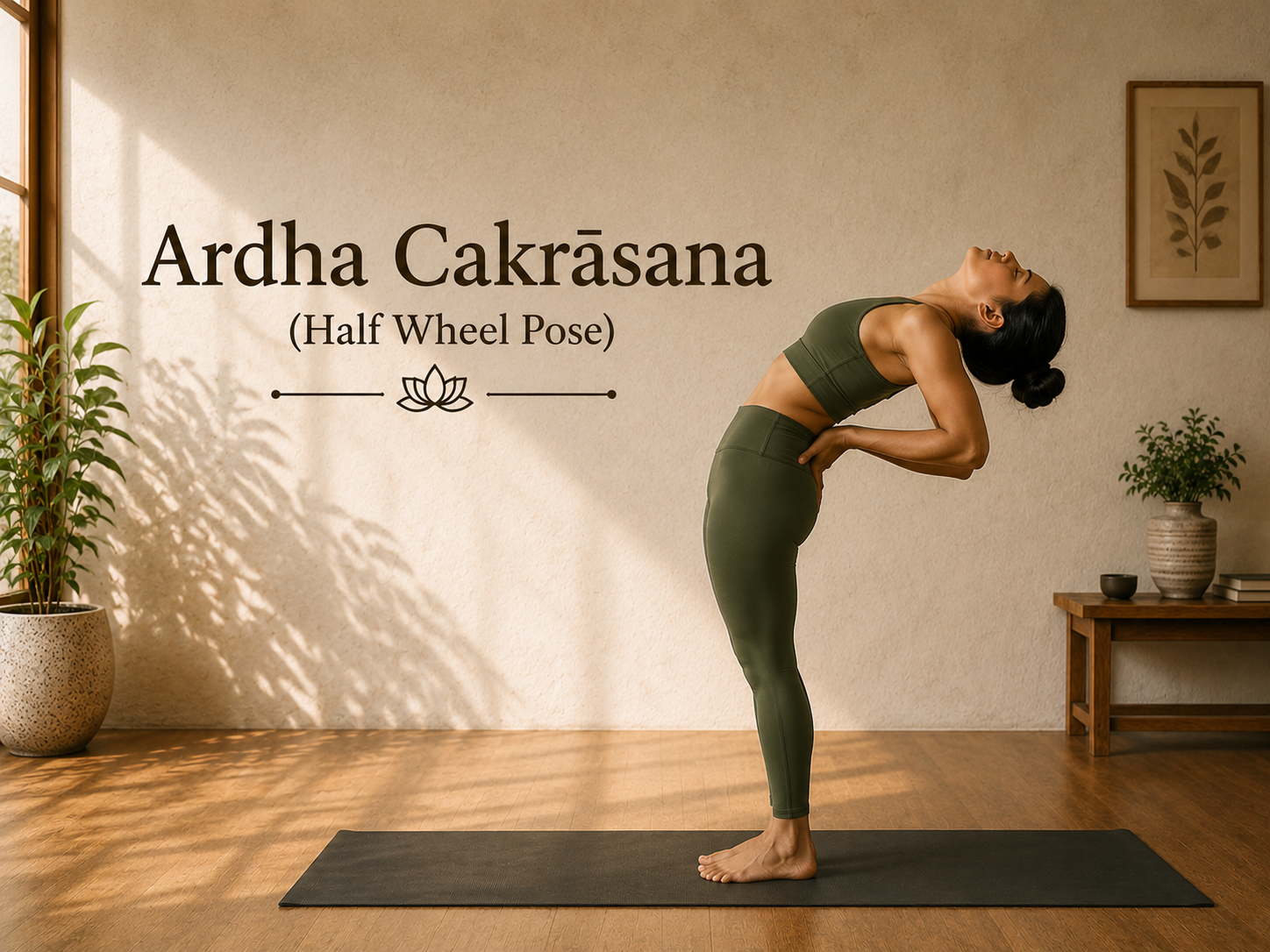
Ardha Cakrāsana (Half Wheel Pose): The Complete Reference Guide
Editorial note, stated once: throughout this article, traditional yogic and Āyurvedic claims (chakra, prāṇa, dosha associations) are presented as traditional belief, not scientific fact, unless a specific evidence source is cited alongside them.
Name & Meaning
- Sanskrit: अर्द्ध चक्रासन (Ardha Cakrāsana)
- IAST Transliteration: Ardha Cakrāsana
- English: Half Wheel Pose / Standing Backbend
- Etymology: Ardha (half) + Cakra (wheel) + Āsana (posture / seat). "The standing posture forming half of a wheel arch by bending the upper body backward."
Introduction
- Ardha Cakrāsana is a fundamental standing backbend posture that opens the entire anterior kinetic chain—stretching the hip flexors, rectus abdominis, intercostals, and pectorals while strengthening the posterior spinal extensors.
- In classical and modern postural yoga systems, Ardha Cakrāsana serves as an accessible entry point to standing backbends, acting as an essential precursor to Urdhva Dhanurāsana (Full Wheel) and a core element in various Sun Salutation warm-up variations.
- Serves as a counter-posture to habitual sitting, forward slouching, and kyphotic posture by encouraging thoracic extension and abdominal lengthening.
- Functions as a clinical diagnostic posture for assessing anterior hip flexor tightness, thoracic spine mobility, and lumbar spinal extension control.
Benefits
- Physical: Lengthens the iliopsoas, rectus femoris, abdominal wall, and intercostal muscles; strengthens gluteus maximus, hamstrings, and spinal erectors; mobilizes the thoracic spine.
- Respiratory & Chest Opening: Expands the ribcage and lifts the sternum, increasing chest cavity volume and facilitating deeper diaphragmatic breathing.
- Mental: Opening the anterior chest and throat stimulates alertness, dispelling sluggishness and building confidence in moving backward in space.
- Postural Correction: Directly counteracts desk-bound sedentary posture (rounded shoulders and tight hip flexors) by restoring extension to the hips and upper back.
- Traditional/Spiritual: Believed in traditional Haṭha Yoga to stimulate Anāhata (heart) and Viśuddha (throat) chakras, while balancing Prāṇa Vāyu across the upper chest—traditional belief, not a scientific claim.
How to Practice Ardha Cakrāsana: Step-by-Step
| Step | Action | Breath | Teacher Cue |
|---|---|---|---|
| 1 | Begin in Tāḍāsana with feet hip-width apart (or together for advanced practitioners). Ground evenly through both foot tripods. | Natural breath | "Root into your heels and stand tall before arching." |
| 2 | Place palms supporting the lower back/sacrum with fingers pointing down (or pointing up for greater chest lift), elbows pointing back. | Exhale to support back | "Support your sacrum with your hands and draw your elbows towards each other." |
| 3 | Inhale deeply, engage the quadriceps and glutes, lift the chest and sternum upward toward the ceiling. | Inhale to lift chest | "Lift your heart upward first before leaning back." |
| 4 | Exhale, gently arch the upper back backward, shifting hips slightly forward over ankles while keeping knees soft (micro-bent). | Exhale to arch back | "Arch through your upper back like a rainbow; do not dump into your lower spine." |
| 5 | Extend neck naturally in line with the curve of the spine (do not drop head aggressively). Hold for 5 to 8 deep, steady breaths. | Steady, smooth breathing | "Keep breathing smoothly into your upper chest cavity." |
| 6 | To release, inhale, engage core flexors, press firmly into heels, and slowly return upright. Pause in Tāḍāsana or follow with Uttānāsana. | Inhale to rise | "Press through your heels and lift from your sternum to stand upright smoothly." |
Common Mistakes & Corrections
- Crunching into the lower back (lumbar compression): Bending only from the flexible L5-S1 junction instead of extending the thoracic spine → Correction: Support sacrum with hands, pull abdominal wall lightly in, and focus on lifting sternum toward ceiling.
- Hyperextending and locking the knees: Forcing knee joints backward shifts body weight incorrectly and strains ligaments → Correction: Keep knees micro-bent and engage quadriceps actively.
- Dropping head backward aggressively: Compressing cervical vertebrae and compromising vertebral artery blood flow → Correction: Keep neck extended naturally in line with thoracic spine; look softly upward.
- Holding breath during backbend: Tensing throat and diaphragm out of fear → Correction: Maintain steady, soft, diaphragmatic breathing into upper ribcage.
Contraindications & Precautions
- Severe Low Back Pathology / Acute Spondylolisthesis / Disc Herniation: Extension can exacerbate lumbar facet irritation or disc compression; practice with minimal depth or avoid during acute pain.
- Severe Cervical Spine Issues: Avoid extending the neck backward; keep chin slightly tucked toward chest.
- Uncontrolled High Blood Pressure or Vertigo: Standing backbends can induce transient blood pressure fluctuations or dizziness; practice near a wall or seated.
- Late Pregnancy: Deep abdominal stretching can strain rectus abdominis; keep backbend very mild with wide foot stance.
Sequencing: Preparatory, Follow-up & Variations
- Preparatory Poses: Tāḍāsana (standing baseline), Bhujangāsana (Cobra Pose for thoracic extension), Anjaneyāsana (Low Lunge for hip flexors).
- Placement in Sequence: Early standing sequence or warm-up section; acts as the standing backbend in Sūryanamaskāra variations.
- Follow-up Poses: Uttānāsana (Standing Forward Bend counter-pose), Pādāṅguṣṭhāsana, Adho Mukha Śvānāsana.
- Variations: Overhead Arm-Extended Half Wheel (Hastottānāsana style), Wall-Supported Half Wheel, Chair-Supported Backbend.
In more detail: Ardha Cakrāsana acts as a foundational backbending bridge. By introducing spinal extension while standing on two grounded feet, it prepares the nervous system, hip flexors, and shoulders for deeper backbends like Uṣṭrāsana (Camel Pose) or Urdhva Dhanurāsana (Full Wheel). Following Ardha Cakrāsana with a gentle forward bend like Uttānāsana neutralizes spinal erectors and releases residual tension in the lower back.
Modifications
- Beginners: Keep feet hip-width apart for a broader base of support; keep hands firmly pressed against sacrum to physically guide lumbar support.
- Tight Shoulder / Chest: Keep hands on sacrum rather than reaching arms overhead; focus strictly on sternum lift.
- Seniors / Balance Issues: Stand with back a few inches away from a wall, leaning shoulder blades gently against wall for safety.
- Lumbar Sensitivity: Keep backbend minimal—focus 90% on lifting chest upward and only 10% on arching backward.
Historical Background & Classical References
- Modern Postural Tradition: Ardha Cakrāsana is a modern descriptive posture developed in 20th-century postural yoga traditions (including Iyengar, Bihar School of Yoga, and S-VYASA).
- Absence in Medieval Scriptures: The exact posture name Ardha Cakrāsana is not found in medieval Haṭha manuals like the Haṭhayogapradīpikā or Gheraṇḍa Saṃhitā (which describe full backbends or seated postures).
- Functional Role: Adopted widely in modern therapeutic and institutional yoga for postural correction and Sun Salutation flows.
Alignment Principles (Iyengar Method)
- Foot Base: Feet parallel, grounded evenly across foot tripod. Knees lifted by active quadriceps, micro-bent to prevent hyperextension.
- Pelvis Mechanics: Pelvis stays supported over heels; hip flexors open forward while glutes engage to support sacrum.
- Thoracic Dominance: Curve originates in upper and mid-back (thoracic spine); collarbones remain broad and shoulder blades draw down.
- Hand Placement: Palms firmly pressed into sacrum/iliac crests, thumbs wrapping around lower waist to guide anterior pelvis stabilization.
Anatomy & Biomechanics
- Primary Stretched Muscles: Rectus abdominis, External/Internal obliques, Iliopsoas, Rectus femoris, Pectoralis major/minor, Intercostals.
- Primary Strengthening Muscles: Gluteus maximus, Hamstrings, Erector spinae, Multifidus, Intrinsic foot muscles.
- Joint Mechanics: Hip extension; lumbar and thoracic spinal extension; shoulder extension (hands on back) or elevation (arms overhead); ankle dorsiflexion/neutral.
- Biomechanics of Sacral Support: Pressing hands into sacrum provides an external biomechanical anchor that prevents excessive lumbar shearing at L5-S1, distributing bending forces into thoracic vertebrae.
Nervous System & Breathing Effects
- Sympathetic Activation & Alertness: Chest opening and anterior body extension stimulate sympathetic ganglia along the spine, boosting mental alertness.
- Respiratory Volume: Lengthening the intercostal muscles increases ribcage expansion, increasing tidal volume capacity.
Yogic & Āyurvedic Perspective
- Dosha Impact: Pacifies Kapha (relieves sluggishness and opens chest) and balances Vāta when grounded through feet. Can increase Pitta if practiced forcefully in hot conditions—traditional belief.
- Prāṇa Dynamics: Stimulates Prāṇa Vāyu at the heart and chest center, encouraging upward energy flow and metabolic vitality.
Therapeutic Applications
| Condition | Mechanism | Research / Precaution |
|---|---|---|
| Postural Kyphosis / Slouched Desk Posture | Extends thoracic spine and stretches shortened pectoral and abdominal muscles | Supported by postural physical therapy principles. Precaution: Keep sacrum supported with hands. |
| Shallow Breathing / Chest Tightness | Lengthens intercostal muscles and expands anterior thoracic cavity | Supported by respiratory biomechanics. Precaution: Do not strain neck. |
Yoga is never a replacement for medical treatment; serious or persistent conditions require a qualified healthcare professional.
Teaching Cues & Hands-On Adjustments
- Verbal Cues: "Support your lower back with your hands like a supportive belt." / "Inhale to lift your chest toward the sky before arching back." / "Keep your knees soft and your heels rooted."
- Hands-on Adjustment (Safe execution with consent):
- Stand beside student; place one hand gently against sacrum to prevent backward collapse, and place other hand lightly between shoulder blades to cue thoracic lift.
Myth vs. Fact
| Myth | Fact |
|---|---|
| The goal of Half Wheel is to bend as far backward as possible at the waist. | The true goal is lifting the chest and extending the thoracic spine safely while protecting the lower back. |
| Ardha Cakrāsana is described in ancient 2,000-year-old scriptures. | It is a modern 20th-century postural posture developed for warm-up, postural correction, and Sun Salutations. |
| You should drop your head back as far as it can go. | Dropping the head back aggressively compresses cervical vertebrae; the neck should follow the natural arc of upper back. |
Conclusion
Ardha Cakrāsana (Half Wheel Pose) serves as an indispensable standing backbend for modern practitioners. By opening the chest, lengthening tight hip flexors, and strengthening posterior spinal extensors, it effectively counteracts the physical strains of sedentary posture. Practiced with proper sacral support and thoracic focus, Ardha Cakrāsana restores vitality and spinal extensibility.
Quick Facts
| Category | Standing backbend / posture |
| Difficulty Level | Beginner |
| Primary Muscles Stretched | Rectus Abdominis, Iliopsoas, Intercostals, Pectoralis Major |
| Primary Muscles Strengthened | Erector Spinae, Gluteus Maximus, Hamstrings |
| Classical Source? | No (Modern 20th century posture) |
| Traditional Chakra (Belief) | Anāhata (Heart) & Viśuddha (Throat) |
Frequently Asked Questions
What does Ardha Cakrāsana mean?
Ardha (half) + Cakra (wheel) = Half Wheel Pose.
Why does my lower back pinch in Half Wheel Pose?
Pinching occurs when bending sharply from the lower back (L5-S1) instead of lifting the chest to extend the thoracic spine. Use hand sacrum support and lift sternum high.
Is Ardha Cakrāsana suitable for beginners?
Yes, it is one of the most accessible standing backbends when practiced with feet hip-width apart and hands supporting sacrum.
How is Ardha Cakrāsana different from Urdhva Dhanurāsana?
Ardha Cakrāsana is a standing half-backbend, while Urdhva Dhanurāsana (Full Wheel) is a full inverted backbend supported on hands and feet on floor.
Can I practice Half Wheel Pose with high blood pressure?
Practice with caution: keep backbend minimal and keep gaze facing forward rather than arching deeply back.
How long should I hold Half Wheel Pose?
Hold for 5 to 8 steady breaths (about 20 to 30 seconds), focusing on chest opening.
References
1. Classical Yoga Texts: Modern posture; absent in medieval Hatha manuals (Haṭhayogapradīpikā, Gheraṇḍa Saṃhitā).
2. Modern Yoga Institutions: Bihar School of Yoga (Asana Pranayama Mudra Bandha). Iyengar, B.K.S. (1966). Light on Yoga. Schocken Books. S-VYASA Yoga University manuals.
3. Peer-Reviewed Scientific Research:
- Sherman, K. J., et al. (2011). A randomized trial comparing yoga, stretching, and a self-care book for chronic low back pain. Archives of Internal Medicine, 171(22), 2019-2026.
- Ni, M., et al. (2014). Comparative muscle activation patterns during yoga postures in elderly adults. BMC Complementary and Alternative Medicine, 14, 401.
This article is for educational purposes and does not replace individualized medical or physical therapy advice. Consult a qualified healthcare provider before beginning any new practice, especially with a pre-existing health condition.