Ardha Baddha Padmottānāsana (Half Bound Lotus Intense Stretch Pose): Classical Sources, Anatomy, Alignment & Evidence-Based Guide
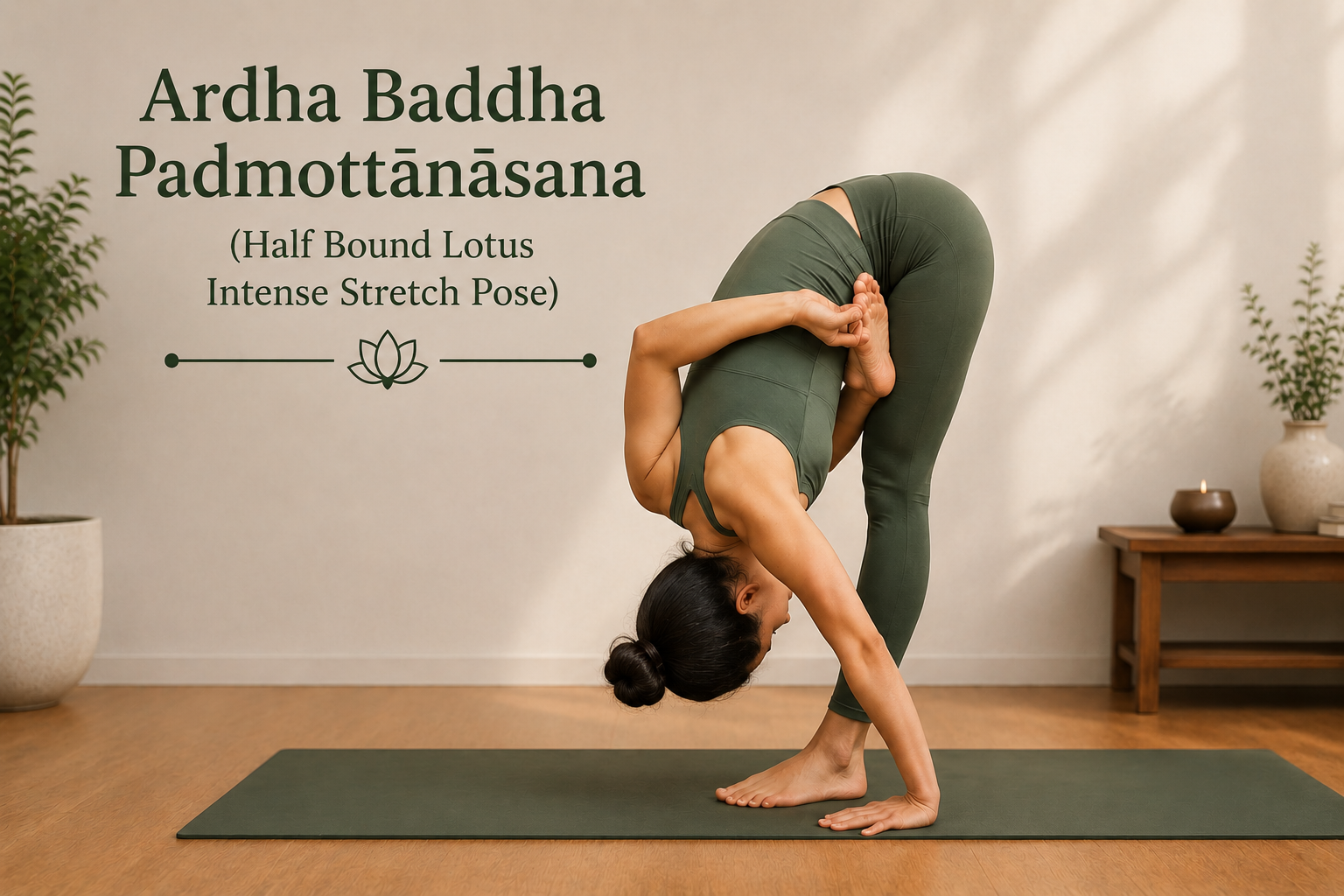
Ardha Baddha Padmottānāsana (Half Bound Lotus Intense Stretch Pose): The Complete Reference Guide
Editorial note, stated once: throughout this article, traditional yogic and Āyurvedic claims (chakra, prāṇa, dosha associations) are presented as traditional belief, not scientific fact, unless a specific evidence source is cited alongside them.
Name & Meaning
- Sanskrit: अर्धबद्धपद्मोत्तासन (Ardha Baddha Padmottānāsana)
- IAST Transliteration: Ardha Baddha Padmottānāsana / Ardha Baddha Padmottanasana
- English: Half Bound Lotus Intense Stretch Pose / Standing Half Lotus Forward Fold
- Etymology: Ardha (half) + Baddha (bound) + Padma (lotus) + Ut (intense) + Tāna (stretch / extension) + Āsana (pose). "The intense standing forward fold featuring a half lotus leg placement and an arm bind behind the back."
Introduction
- Ardha Baddha Padmottānāsana is a signature, deeply transformative standing balance and forward fold in Ashtanga Vinyasa and Iyengar Yoga, serving as a gateway test for lotus flexibility and hamstring openness.
- Characterized by standing upright, drawing one foot into a half-lotus position atop the opposite hip crease, binding the corresponding arm behind the back to catch the big toe, and hinging forward from the hips to rest the chest and nose toward the standing shin.
- Extensively documented in classical texts by K. Pattabhi Jois in Yoga Mala and B.K.S. Iyengar in Light on Yoga.
- Functions as an outstanding clinical diagnostic for evaluating hip external rotation range of motion, knee meniscus safety under weight-bearing, hamstring extensibility, and single-leg balance control.
Benefits
- Standing Leg Hamstring & Calf Elongation: Intensely stretches the hamstrings, gastrocnemius, and posterior fascial chain of the standing leg.
- Hip Capsule External Rotation Mobility: Opens deep soft tissues surrounding the hip socket of the folded leg.
- Shoulder Girdle & Pectoral Fascia Opening: Reaching the arm behind the back to bind the big toe broadens the chest and mobilizes the upper shoulder joint.
- Single-Leg Balance & Proprioceptive Focus: Demands acute neuromuscular stabilization on a single standing foot while folded forward.
- Traditional/Spiritual: Believed to stimulate Svādhiṣṭhāna (sacral) and Maṇipūra (solar plexus) chakras, awaken inner stillness, and focus restless mental energy—traditional belief, not a scientific claim.
How to Practice Ardha Baddha Padmottānāsana: Step-by-Step
| Step | Action | Breath | Teacher Cue |
|---|---|---|---|
| 1 | Stand tall in Tadasana. Shift your weight onto your left foot. Bend your right knee, cup your right foot with both hands, and place the top of your right foot high into your left hip crease (Half Lotus). | Natural breath | "Stand tall, shift weight left, and tuck your right foot high into your left hip crease." |
| 2 | Point your folded right knee straight down toward the floor. Reach your right arm behind your back and wrap it around to clasp your right big toe. (Use a strap if toe is out of reach). | Exhale to bind arm | "Point your folded knee downward, wrap your right arm behind your back, and catch your big toe." |
| 3 | Inhale, lift your left arm straight up overhead to lengthen your spine. Exhale, hinge forward strictly from your left hip crease, bringing your left hand down to the floor beside your left foot. | Inhale reach up, exhale fold | "Inhale reach up, exhale hinge from your hip crease and fold forward to the floor." |
| 4 | Rest your gaze toward your shin or big toe. Keep your standing leg active with a micro-bend in the knee. Hold for 5 steady breaths. | Slow, steady diaphragmatic breathing | "Gaze toward your shin, keep your standing leg active, and breathe steadily." |
| 5 | To exit, inhale, press firmly into your standing foot, engage your core, and rise smoothly back up to standing. Release your leg and shake it out. Repeat on the left side. | Inhale to rise up | "Inhale, press into your standing foot, rise up with control, and release." |
Common Mistakes & Corrections
- Forcing the foot into half lotus despite hip restriction: Forcing rotation twists the knee joint rather than the hip socket → Correction: Never force half lotus if your knee feels pinched; practice standard standing forward fold (Uttanasana) or use a strap.
- Rounding the spine instead of hinging from hips: Collapsing the chest forward strains vertebrae → Correction: Lengthen your spine forward from your hip creases before folding down.
- Locking the standing knee into hyperextension: Jamming the knee backward impairs balance and overloads joint ligaments → Correction: Maintain a soft micro-bend in your standing knee.
Contraindications & Precautions
- Acute Knee Pathology (Meniscus or Ligament Tear): Half lotus places heavy torque on knee joints; avoid entirely if knee pain is present.
- Acute Hamstring or Lower Back Strain: Forward folding under load with a bind requires careful hamstring conditioning.
- Severe Balance Impairment: Practicing unsupported requires strong single-leg stability; practice near a wall.
Sequencing: Preparatory, Follow-up & Variations
- Preparatory Poses: Padmāsana (Lotus), Ardha Baddha Padmottānāsana variations, Vṛkṣāsana (Tree Pose), Uttānāsana.
- Placement in Sequence: Standing balancing and opening block in Ashtanga Primary Series or Vinyasa flows.
- Follow-up Poses: Vinyasa counter-stretches (Downward Dog), Tadasana, Bālāsana.
- Variations:
- Upright Half Bound Lotus: Staying upright in the half lotus bind and balance without folding forward.
- Strap-Assisted Half Lotus: Using a yoga strap around the bound foot if hand-to-toe bind is out of reach.
Modifications
- Use a Yoga Strap for the Bind: Loop a yoga strap around your bound foot if your hand cannot comfortably clasp your big toe.
- Practice Near a Wall: Rest your back or hands lightly against a wall while folding to maintain balance stability.
- Skip Half Lotus Tuck: Practice standard standing forward fold if hip or knee restrictions prevent half lotus placement.
Historical Background & Classical References
- Ashtanga Primary Series: Codified by K. Pattabhi Jois in Yoga Mala as a foundational standing posture bridging lotus flexibility with deep forward bending.
Alignment Principles (Iyengar Method)
- Hip-Crease Hinging: Forward folding originates strictly from the hip joints rather than waist rounding.
- Knee Directionality: The folded knee points straight down toward the floor, protecting internal knee structures.
- Standing Leg Grounding: Four corners of the standing foot press evenly into the mat.
Anatomy & Biomechanics
- Primary Stretched Muscles: Hamstrings (standing leg), Gluteus Maximus, Piriformis (folded leg), Latissimus Dorsi.
- Primary Active/Strengthening Muscles: Quadriceps Femoris (standing leg), External Hip Rotators, Erector Spinae.
- Joint Mechanics: Standing hip flexion and knee extension; folded hip external rotation, abduction, and flexion; knee flexion; spinal flexion.
- Hip Rotation Biomechanics: Placing the foot in half lotus requires the femur to rotate externally within the acetabulum (hip socket). If the hip capsule is stiff, practitioners often incorrectly twist from the knee joint, risking meniscus injury.
Nervous System & Breathing Effects
- Parasympathetic Forward Fold Soothing: Inverted forward folding combined with steady breathing triggers vagal relaxation responses.
Yogic & Āyurvedic Perspective
- Dosha Impact: Pacifies erratic Vāta through intense grounding and builds focused Pitta discipline—traditional belief.
- Prāṇa Dynamics: Channels Apāna Vāyu downward into the earth, fostering profound mental quietude.
Therapeutic Applications
| Condition | Mechanism | Research / Precaution |
|---|---|---|
| Tight Hamstrings & Calves | Single-leg standing forward fold elongates posterior myofascial chains | Supported by hamstring flexibility literature. Precaution: Keep standing knee soft. |
| Hip External Rotation Restriction | Controlled half-lotus placement mobilizes hip capsule soft tissues | Supported by hip mobility protocols. Precaution: Never force knee joint rotation. |
Yoga is never a replacement for medical treatment; serious or persistent conditions require a qualified healthcare professional.
Teaching Cues & Hands-On Adjustments
- Verbal Cues: "Place your foot safely into your hip crease, point your knee down, and hinge forward from your hip joints." / "Keep a micro-bend in your standing knee." / "Breathe smoothly and let your head relax toward your shin."
- Hands-on Adjustment (Safe execution with consent):
- Stand beside student; place your hand lightly on their lower back to help guide their hinge forward from the hip creases rather than rounding the spine.
- Ensure their folded knee is safe and pointing downward without lateral torque.
Myth vs. Fact
| Myth | Fact |
|---|---|
| Knee pain in half-lotus forward folds is just normal stretching discomfort. | Sharp or dull knee pain indicates dangerous torque on the knee joint; lotus variations must originate entirely from the hip socket, never the knee. |
| You must touch your nose to your shin on your very first attempt. | Hamstring and hip opening take months or years of consistent practice; folding with a long spine is far more important than touching your head to your leg. |
Conclusion
Ardha Baddha Padmottānāsana is a magnificent, classic posture uniting single-leg balance, lotus hip opening, arm binding, and deep forward folding. By respecting your knee joints, hinging from your hips, and breathing with steady awareness, you master this advanced posture safely.
Quick Facts
| Category | Standing balance / Forward fold / Hip opener |
| Difficulty Level | Advanced |
| Primary Muscles Stretched | Hamstrings, Gluteus Maximus, Piriformis, Latissimus Dorsi |
| Primary Muscles Active | Quadriceps Femoris, External Hip Rotators, Erector Spinae |
| Classical Source? | Yes (Formalized in Ashtanga Primary Series & Iyengar yoga) |
| Traditional Chakra (Belief) | Svādhiṣṭhāna (Sacral) & Maṇipūra (Solar Plexus) |
| Dosha Impact (Belief) | Pacifies Vāta & builds Pitta focus |
Frequently Asked Questions
What does Ardha Baddha Padmottānāsana mean in English?
Ardha (half) + Baddha (bound) + Padma (lotus) + Ut (intense) + Tāna (stretch) + Āsana (pose) = Half Bound Lotus Intense Stretch Pose.
Why does my knee hurt in half lotus forward folds?
Knee pain means your hip external rotators are tight, forcing your knee joint to twist. Never force half lotus; use a strap or skip the lotus tuck if you feel any knee discomfort.
Can I use a yoga strap in this pose?
Yes! Using a yoga strap around your bound foot is an exceptional modification if your hand cannot yet reach your big toe.
How long should I hold this pose?
Hold for 5 steady breaths (about 15 to 30 seconds) on each leg.
References
1. Modern Classical Texts: Jois, K. Pattabhi (2002). Yoga Mala. North Point Press. Iyengar, B.K.S. (1966). Light on Yoga. Schocken Books.
2. Peer-Reviewed Scientific Research:
- Sherman, K. J., et al. (2011). A randomized trial comparing yoga, stretching, and a self-care book for chronic low back pain. Archives of Internal Medicine, 171(22), 2019-2026.
- Ni, M., et al. (2014). Comparative muscle activation patterns during yoga postures in elderly adults. BMC Complementary and Alternative Medicine, 14, 401.
This article is for educational purposes and does not replace individualized medical or physical therapy advice. Consult a qualified healthcare provider before beginning any new practice.